My Mother Burned My Dissertation


Well, not the dissertation itself. That would have been unthinkable. It was expensive to have a dissertation bound, and I needed three copies. What my mother eventually burned were the materials from which the dissertation had been made: shoeboxes filled with index cards, stacks of cassette tapes, teczki (folders) stuffed with notes, drafts, and other pieces of paper that had occupied my room while I was writing.
She had complained about them for years. They cluttered the room, she said, and they were a fire hazard. The latter was not entirely maternal exaggeration. We lived in an apartment heated by coal-burning tiled stoves, piece kaflowe, and when the fire was being started in the morning, there could be sparks.
In May 1984, I defended my dissertation. In June, I left for the United States. Neither my mother nor I knew that I was leaving Poland permanently. At some point after I left, she asked whether she could finally burn the boxes of cards and notes.
I said yes.
Shoebox Scholarship
The shoeboxes themselves were hardly an elegant filing system. They didn't even match. I collected them from neighbors because we simply did not have enough shoeboxes in our apartment to contain all the index cards my literature review generated. Gradually, a motley collection of boxes became my literature database.
The index cards accompanied me to the university library. I would carry a stack in my tote bag and place them on the table in the main reading room. As I read, I copied passages I thought I might need onto the cards, by hand and usually in pencil.

The cards themselves were color-coded and perforated. The colors helped me organize different kinds of material, while the holes provided another way of sorting and retrieving information. A long knitting needle inserted through the appropriate holes allowed me to pull out the cards belonging to a particular category.
This was how I searched the literature.
The interviews produced a different collection of paper. I recorded some of them on cassette tapes, but there were no digital recordings and certainly no automated transcripts. I transcribed the interviews myself, in longhand, into zeszyty (notebooks). The notebooks, along with fieldnotes and other research materials, were kept in folders.
By the time I finished the dissertation, its physical infrastructure occupied a considerable amount of space.
My mother had a point about the clutter.
Material Scholarship
Looking back, what strikes me is how physical the entire process was. Research did not merely produce paper; doing research required moving paper from one place to another. I carried blank index cards to the library and brought them home covered with quotations. I sorted them, coded them, and retrieved them physically. I listened to recorded voices on cassette tapes and transformed them, by hand, into pages of written text. Drafts accumulated. So did notebooks and folders.
Even searching involved physical movement. Finding a book meant consulting a catalog, locating it in the library system, and getting the book into my hands. Finding something I had previously read meant remembering how I had classified it and returning to the appropriate shoebox.
None of this seemed quaint at the time. It was simply how scholarly work was done.
And I don't particularly miss it.
Same Room
The main reading room at Adam Mickiewicz University has changed remarkably little. The long wooden tables are still there. So are the green lamps, the tall windows, and the walls of books.
But look at those tables today.
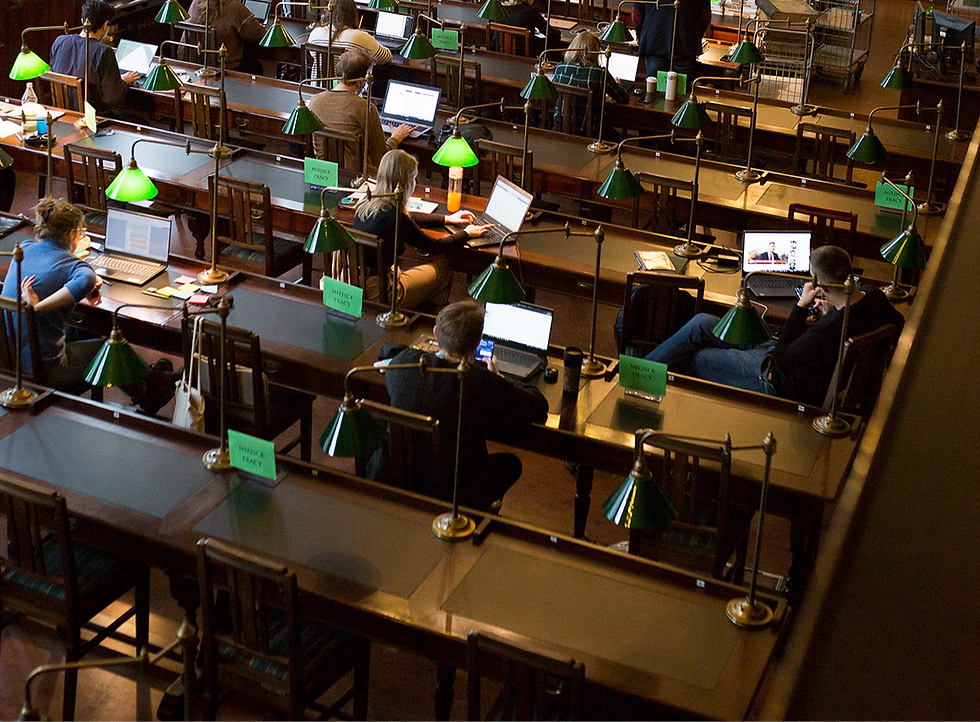
Almost every student has a laptop open in front of them. There are still books, notebooks, loose sheets of paper, and pens. The older tools have not vanished. But they now share the table with technologies that have profoundly changed how scholars find, record, organize, retrieve, and write about information.
The room remained much the same. The warsztat changed, but perhaps not as completely as those laptops suggest.
What Remained
The warsztat changed, but not everything changed with it.
I certainly don't miss copying quotations from books by hand, and I have no desire to resurrect my shoebox database. I happily search electronic databases, download articles, and retrieve passages with a few keystrokes. But some of my old habits have proved surprisingly resistant to technological change.
I still print articles when I am working closely with them. I highlight passages that are important to my argument or that I may want to cite. I use different colors for different themes and add different colored sticky notes along the edges. When I am deep into an analysis, I can spread several articles across a table or the floor and see, almost at a glance, where particular themes appear and how they might relate to one another.
Of course, I can do much of this on a screen. I can highlight a PDF in several colors, annotate it, search it, and find every occurrence of a particular word in seconds. In many respects, that is vastly more efficient than anything I could do with my shoeboxes and knitting needle.
But it isn't quite the same.
For me, paper has a spatial and visual quality that a screen doesn't fully reproduce. A stack of articles covered with colored highlights and protruding sticky notes becomes a kind of map of my thinking. I can spread the pieces out, move among them, put two things next to each other that had not previously seemed connected, and see patterns emerging across several texts at once.
Perhaps this attachment to the physical page goes back further than my dissertation. When I was in school in Poland, some teachers allowed us to prepare a ściąga, a small cheat sheet, before an exam. The logic was wonderfully paradoxical: if we had to decide what was important enough to fit on a very small piece of paper and then write it out by hand, we would probably remember much of it. The ściąga might become unnecessary precisely because we had made it.
Perhaps none of this is surprising. I was a Montessori mother, and I have always paid attention to the relationship between thinking and the environment in which it happens. The materials matter to me. So does their arrangement. I still buy index cards and rejoice in the multiplicity of colors now available. Sometimes I want ideas to be physically separate, movable, sortable, and visible all at once.
And index cards have not disappeared from my ethnographic warsztat either. I still use them in fieldwork when I am trying to uncover a particular taxonomy. I can give interlocutors cards and ask them to arrange them in ways that make sense to them. They can create groups and subgroups, move something from one category to another, establish different levels, hesitate over where something belongs, or decide that the categories I started with make no sense at all.
The manipulation itself becomes part of the research encounter. I am interested not only in where a card finally ends up, but also in what happens while someone is deciding where to put it. A card can be picked up, moved, returned, placed between two others. Someone can say, “Well, this is kind of like that, but not really...” Those moments of hesitation and rearrangement can reveal precisely the layers and ambiguities I am trying to understand.
A computer or tablet can technically reproduce a sorting exercise. But, for me, it cannot quite reproduce the experience of sitting around a table while people physically manipulate the categories and talk through what belongs where and why.
So perhaps the history of scholarly tools is not a story in which one technology simply replaces another. We abandon some tools, embrace others, and keep still others because they continue to help us think.
What We Keep
When I told my mother she could burn those shoeboxes, notebooks, folders, and the cassette tapes as well, I didn't think of them as an archive. They were the working materials of a dissertation I had finished. The dissertation survived. Why would I need everything that had gone into making it?
I sometimes wonder what I would think if those materials had survived. Would I want to look through the index cards and see what I had underlined, copied, classified, and ultimately left out? Would the handwritten interview transcripts remind me of things that never made their way into the dissertation? Perhaps. But I don't particularly regret giving my mother permission to clear out my room.
What interests me more now is how much the tools of scholarship have changed while some of the practices behind them have remained remarkably persistent. We still have to decide what is worth noticing. We still sort and classify, look for connections, revise categories, return to something we read months or years ago, and occasionally discover that what we thought belonged in one pile really belongs in another.
The technologies through which we do these things will continue to change. The warsztat changes with them. But scholarship is not simply the sum of its tools. It is also the habits of attention we develop around them and the choices we make about which tools help us think.
My mother burned my index cards.
I am still buying them.


Comments